
Topic 4 – AI in the Classroom
From my knowledge AI is a large-scale pattern recognition software that is powered by statistics and optimization. It’s trained on massive datasets through repeatedly predicting, measuring errors, and adjusting itself to improve. I finally listened to my partner and started using AI in 4th year university, although he was well aware of the benefits and use cases for my situation at least the year before that. I was stubborn to start exploring because I did not believe that a computer could solve the conceptually high level math and physics problems I was able to. I was wrong, and my life got a lot easier after learning how to use the tool affectively!
When I was finishing my degree I used ChatGPT to help me get started on particularly difficult physics problems, unfortunately (maybe?) AI can not do math very well, it still makes mistakes but it was much much worse. I remember having arguments with ChatGPT about physics topics, and I think that that actually helped my learning to some degree; for example I would ask it a very complex physics question such as “derive the equations of motion using the Langrangian of a triple pendulum” and AI could respond with something that appears accurate to someone without the knowledge to pick apart the algebra and basic math involved. This would then require me to go through what it has done and tell it where it went wrong, and I need to know where it went wrong to be able to explain it such that the AI knows what to adjust.
The above is one of the reasons that I think that AI can be useful, but I was lucky enough to have AI introduced in the middle of my degree, when I was already almost an expert at the subject I was studying. If I was in my first year or high school then I think that my learning would have been negatively affected.
on a side note, a computational intelligence that does a great job at complex math problems and has a fairly useable interface is called Wolfram Alpha. I have included a link in case anyone was interested in trying it out.
For current high school students of math and physics I think that showing the students how to affectively use AI is important. Perhaps demonstrating how AI can make mistakes and having students correct the errors on occasional assignments would be beneficial for their learning, as well as putting a flicker of doubt in their head about blindly trusting AI. In the time I have recently spent in high school math/physics classes I found that students did not rely on the tool as much as I expected, perhaps this is because students mostly get time to do homework in class, or that the problems they are meant to solve are within their skill level, or just that they already know if they rely on AI they won’t be able to do the problems themselves when they move onto tests and then higher levels. When I did talk to a few teachers about the things they do to avoid students uploading assignments and submitting AI work as their own was that for the most part the students are pretty good about not using it, however a simple trick I learned was to change the variable names (especially in physics) because the AI may get confused if we start calling velocity c instead of v (because c usually represents the speed of light).
Although not directly related to math or physics, while working through the activities I decided to ask my partner what kind of image I should create using AI, he suggested asking it to build a 3D rendering of a house based off of a floor plan that was found on google for the purposes of this experiment. My partner has enough experience building homes to have a rough of idea of whether or not the result is accurate. Here is the prompt (provided to me from my partner because he wanted to make sure we got the most accurate result) and final rendering:
PROMPT
Using the provided floor plan as the spatial and proportional reference, generate a realistic concept exterior elevation rendering of the house. Interpret wall layout, massing, and footprint directly from the floor plan to accurately reflect building width, depth, roof breaks, and overall form. Create a cohesive architectural exterior that matches a modern residential home.
Style: contemporary residential architecture with clean lines, balanced proportions, and realistic materials.
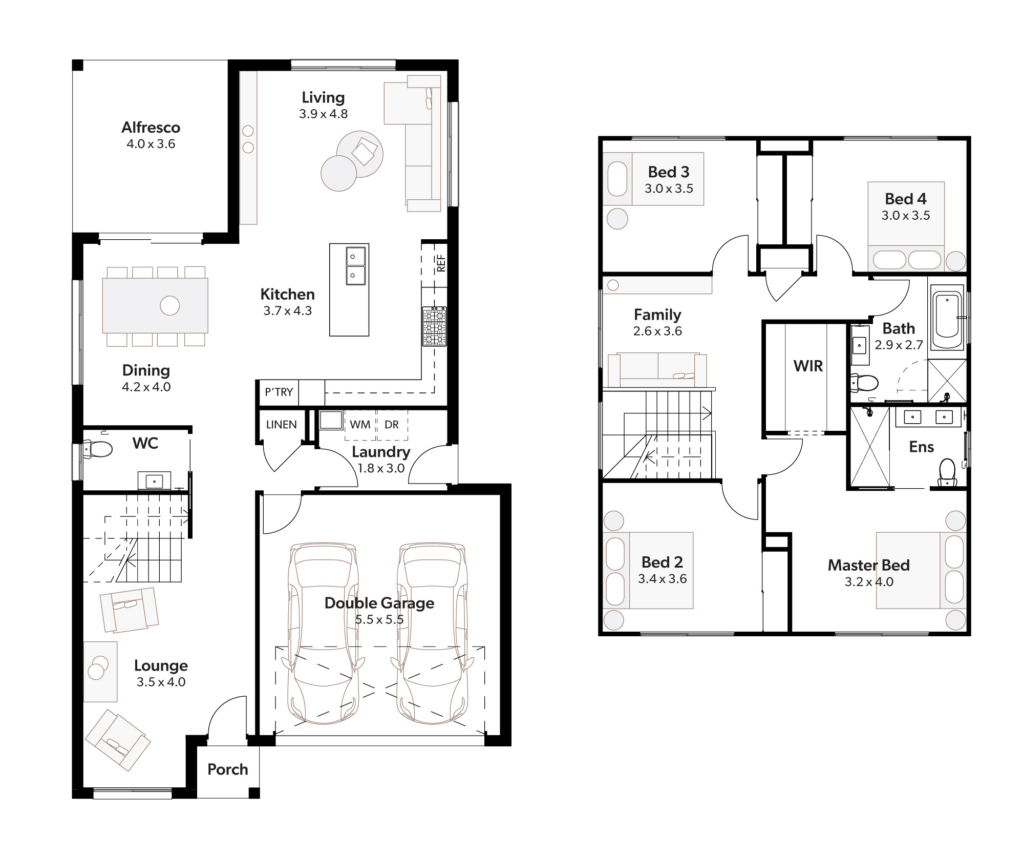
Exterior details:
• Standing-seam metal or architectural asphalt shingle roof
• Combination of horizontal siding, vertical board-and-batten, and accent materials (wood, stone, or fiber-cement)
• Well-proportioned windows aligned logically with the floor plan
• Defined front entry with subtle overhang or porch
• Simple landscaping for scale (walkway, grass, shrubs)
Lighting and rendering:
• Three-quarter perspective exterior elevation view (not floor plan view)
• Eye-level camera angle
• Soft natural daylight, neutral sky
• High-quality architectural visualization, realistic shadows and textures
The result should look like a professional concept exterior rendering suitable for early design review, not a technical drawing.
RENDERING RESULT
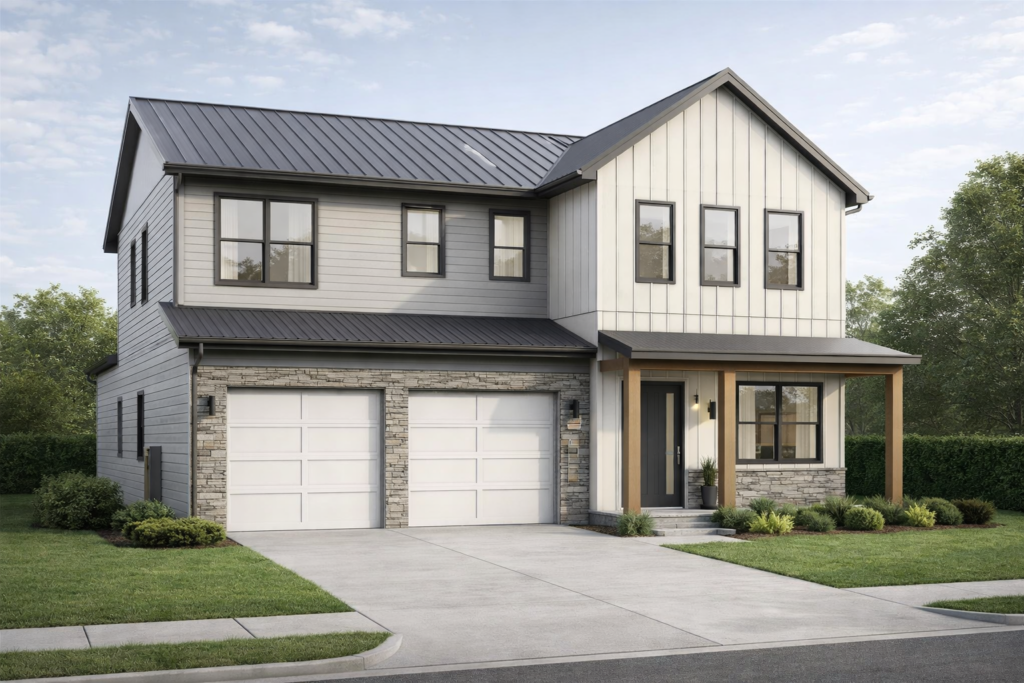
Overall the AI did a poor job, with a final score of 14/30 (see below for the rating breakdown used). My partner and I agreed that it seems like the AI relied much more on the words in the prompt rather than the floor plan provided. Perhaps this could be improved upon by describing the floor plan in words within the prompt.
- Physical accuracy: 2/10 (2 car garage and porch were correct)
- Esthetic accuracy: 8/10 (good shading and reflection in the window, nice colour choices, the random unknown fluid dripping from the roof is weird)
- Minor Detail Accuracy: 4/10 (some random things missing – skirt roofs dying off, no obvious supports, missing railing in the back)